
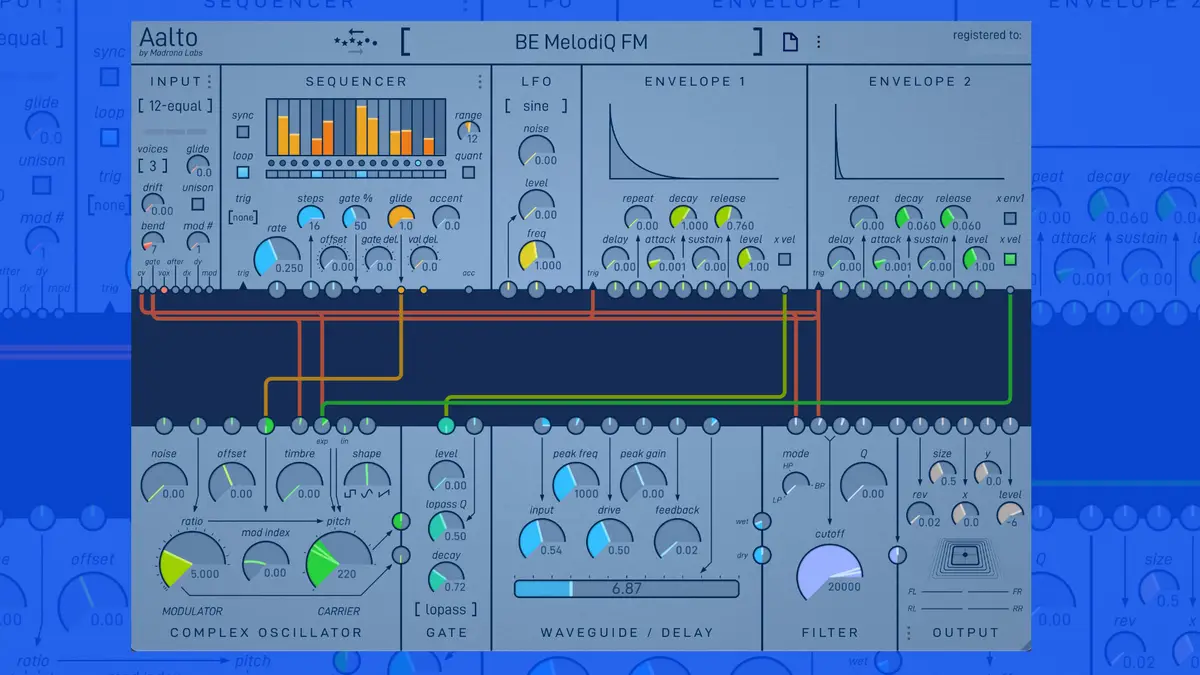
Madrona Labs develops Aalto 2, a software synthesizer plugin that emulates West Coast synthesis techniques. The update modernizes the original 2010 release with a new engine and interface improvements.
Features
Low-pass gate
This circuit combines a filter and amplifier to mimic acoustic decay. The updated version features a refined Vactrol model with a more solid midrange.
Modulation
Nearly every knob now supports an independent, syncable multi-wave LFO.
Patch matrix
The single-screen interface centers on a color-coded patch matrix. This allows users to connect components easily to create complex signals.
Undo/redo
A new widget on the left side of the interface allows users to reverse changes made to the current patch. Keyboard shortcuts are also available for this function.
Voice count
The engine now supports up to eight voices. This is an increase from the one to four voices available in the original version.
Engine and performance
Madrona Labs rewrote the software from scratch to address the high processing load of the previous version. The new graphics engine runs entirely on the system GPU, which significantly reduces CPU usage. The review notes that sessions on a MacBook Air M4 now show usage between 10 and 18 percent, a substantial drop from the 50 percent or more recorded on older hardware. The engine also supports up to eight voices, doubling the maximum polyphony of the original release.
Interface and workflow
The single-page layout remains, but several quality-of-life additions improve usability. A new undo and redo widget allows users to revert patch changes, supported by keyboard shortcuts for actions like undo, redo, and escape. The patch browser has been updated to help organize sounds, though it lacks advanced filtering or tagging. A settings menu has also been added to the interface.
Synthesis and modulation
Aalto 2 retains the core West Coast synthesis elements, including the complex oscillator, waveguide, and low-pass gate. The low-pass gate now uses a more refined Vactrol model, which the review describes as having a more solid midrange. Modulation options have expanded, with nearly every knob now supporting an independent, syncable multi-wave LFO. Users can also assign external modulators via MIDI CC learn and use parameter locks to hold values when loading new patches.
Key facts
- Madrona Labs
- 2010
- 8
- GPU-based
- Multi-wave LFO, MIDI CC