
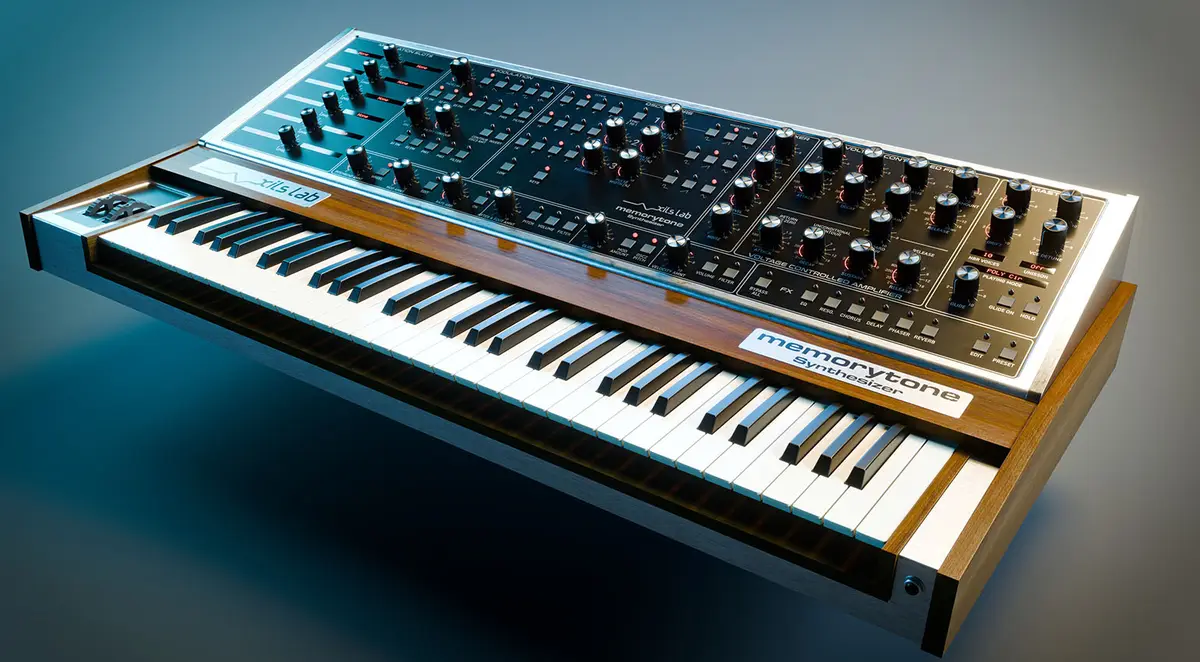
XILS-lab MemoryTone is a software synthesizer that emulates the Moog Memorymoog, a classic analog instrument known for its multiple oscillators per voice.
Features
Oscillators
Each voice contains three oscillators with pulse, sawtooth, and triangle waveforms. Users can adjust pulse width, hard sync, and detune, with the third oscillator also functioning as an LFO.
Filter
The module includes a 24dB/Oct Ladder filter that can be driven into self-oscillation. It processes the combined signal from the oscillators before the output stage.
Modulation
Two ADSR envelope generators and one LFO provide control over pitch, pulse width, and filter parameters. Six assignable slots allow routing to various destinations, including oscillator FM and voice-to-voice detune.
Arpeggiator
An advanced arpeggiator supports mono and polyphonic operation, octave extension, broken chords, and random patterns. It also includes gate and swing controls for rhythmic variation.
Effects
The effects section contains chorus, phaser, delay, reverb, EQ, and a resonator. These tools allow users to shape the final sound beyond the core synthesis engine.
Presets
The plugin includes factory patches originally programmed by Wendy Carlos, Herbert Deutsch, and Jan Hammer. These presets reflect the sound design of the original hardware.
Synthesis engine
XILS-lab developed MemoryTone as a digital recreation of the Moog Memorymoog, following their earlier emulation of the CS-80. The company focused on measuring how the 18 oscillators interact, specifically looking at small variations between voices and how level changes affect the signal before it reaches the filter. The plugin expands the original six-voice architecture to 12 voices while maintaining three oscillators per voice. Each oscillator offers pulse, sawtooth, and triangle waveforms with variable pulse width and hard sync. Detune controls are available for the second and third oscillators, and the third oscillator can operate as an LFO, mirroring the Minimoog's functionality. The 24dB/Oct Ladder filter can be pushed into self-oscillation, and the system supports mono, polyphonic, and circular polyphonic playing modes.
Modulation and performance
The modulation system includes two ADSR envelope generators with advanced contour behavior and an LFO with a rate range of 0.1 to 10Hz. The LFO offers triangle, saw up, saw down, square, and sample and hold waveforms. Modulation destinations include oscillator FM, pulse width, and the filter, with polyphonic voice modulation supported. Six assignable modulation slots provide additional routing flexibility. Expression inputs support velocity, aftertouch, expression, and MPE. The arpeggiator features mono and polyphonic operation, octave extension, broken chord behavior, random patterns, and gate and swing controls. A sequencer is also included for pattern-based performance.
Price and availability
MemoryTone is available for Mac and PC in AAX, VST, VST3, and AU formats. The introductory price is $77, £68, or €79, which rises to €199 on November 1, 2026. The plugin includes factory patches programmed by Wendy Carlos, Herbert Deutsch, and Jan Hammer. The article notes that while the market already has Memorymoog emulations from Arturia and Cherry Audio, XILS-lab's version is distinguished by its sound quality and modern additions like the advanced arpeggiator and effects section.
Videos
Key facts
- $77 introductory
- €199
- Available now
- AAX, VST, VST3, AU
- Mac, PC
- 12
- 3