
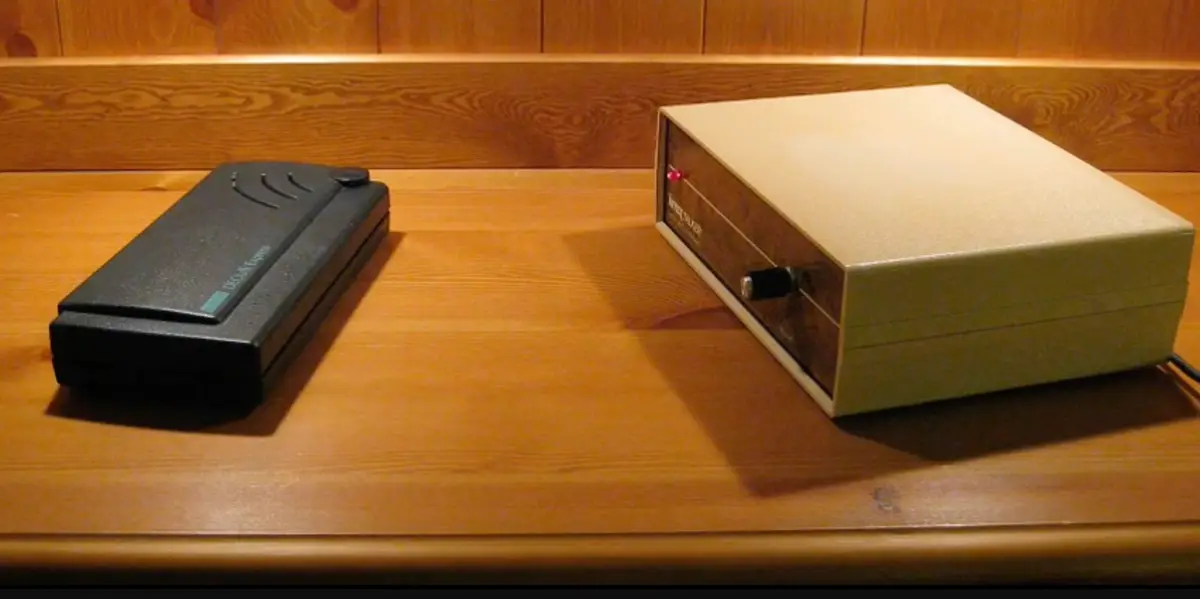
This article describes a performance of a Monty Python sketch using two vintage speech synthesizers, the DECtalk Express and the Intex Talker, to explore the expressive potential of early voice synthesis technology.
Features
DECtalk Express
This device voices the role of Michael Palin in the sketch. Its speech synthesis is based on the original MITalk project and the Perfect Paul model, which was also used for NOAA weather radio.
Intex Talker
Also known as the Votrax SC-01A, this unit voices the role of John Cleese. It was built on the work of Richard T. Gagnon and was used in arcade games, pinball machines, and reading machines for the blind.
Chipspeech
A software tool by Plogue that turns vintage voice models into a playable instrument. The article mentions a track made with a prerelease version of this software, where the text was keyed in by hand with a MIDI keyboard.
Vintage hardware in a classic sketch
The performance features a DECtalk Express and an Intex Talker, which is identified as the Votrax SC-01A. The DECtalk Express takes on the part of Michael Palin, while the Intex Talker handles the lines for John Cleese. The article notes that this combination of retro speech synthesis creates a distinct sound that is described as better, though not necessarily more intelligible, than modern alternatives. The humor of the piece relies on the specific character of these early synthesizers.
Historical context of the technology
The DECtalk Express derives from the MITalk project, where Dennis Klatt developed the Perfect Paul model. This voice became widely known as the synthetic voice for NOAA weather radio. The Intex Talker comes from Votrax, a company originally known as the vocal division of Federal Screw Works. Votrax built its models on the work of Richard T. Gagnon, and the technology was used in arcade games, Gottlieb System 80 pinball machines, and the first generation Kurzweil Reading Machine for the Blind. Both companies are now defunct, but their legacy remains in the sound of these devices.
Speech synthesis as an instrument
The article argues that early voice synthesis could become expressive when played like an instrument. It suggests that relying solely on AI for this function results in a loss of that specific quality. The text references the Voder demo to illustrate how expression was a key concept in early speech synthesis. It also mentions Chipspeech from Plogue, a tool that allows vintage voice models to be played as instruments. The author recalls making a track with a prerelease version of Chipspeech, keying in the text by hand with a MIDI keyboard and using the mod wheel for vibrato.
Key facts
- Michael Palin
- John Cleese
- Votrax SC-01A
- MITalk project
- Richard T. Gagnon
- Chipspeech by Plogue