
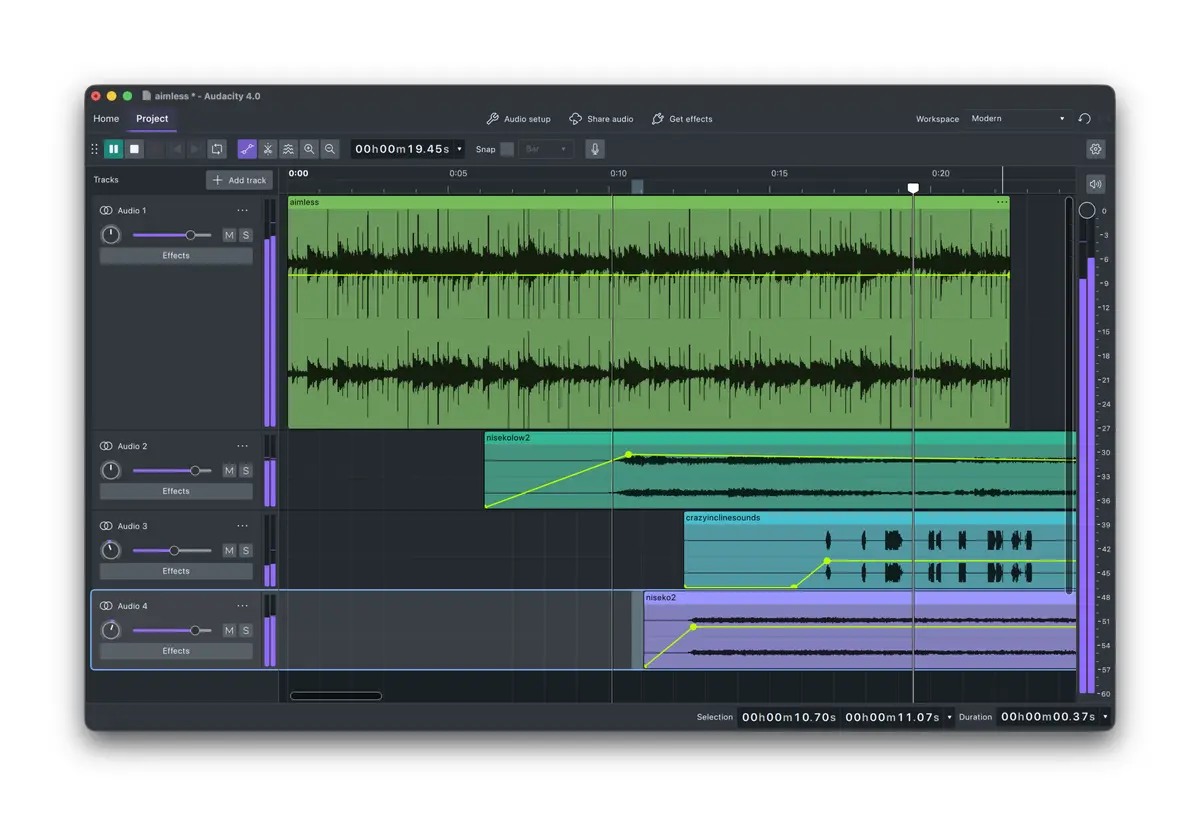
Audacity is a free, open-source audio editor developed by Muse Group that allows users to record and edit sound files on macOS, Windows, and Linux.
Highlights
Reworked UI
The interface includes a new Modern layout with a vertical master meter and customizable toolbars, while retaining the option to use the Classic layout.
Editing tools
New capabilities include a split tool, freely dropped clips, multiple clip selection, gain envelopes, and trim and stretch handles for precise manipulation.
Effects support
The software supports LV2, VST3, and AU plugins, maintains backward compatibility with Audacity 3 files, and offers a redesigned effects interface.
MuseHub
An optional marketplace provides additional effects and plugins for music and podcasting, which can be installed separately from the core application.
Interface and editing improvements
Audacity 4 introduces a significant visual and functional update to the long-standing audio editor. The new Modern layout positions the master meter vertically on the side of the screen, freeing up space in the toolbar. Users can customize which icons appear in this view or revert to the Classic layout if preferred. The editing workflow benefits from new tools such as a split function, the ability to drop clips freely, and the selection of multiple clips for simultaneous moving, trimming, or stretching. Gain envelopes and trim and stretch handles are also available, addressing previous limitations in the software's editing precision.
The application is built with the Qt framework, which the article notes contributes to a snappy performance compared to some proprietary alternatives. A spectral view is included for analyzing audio content, and the effects interface has been redesigned. The software maintains full backward compatibility with Audacity 3 project files and supports LV2, VST3, and AU plugin formats. Per-track metering, markers, regions, and loop region controls are part of the updated feature set, alongside direct sample editing and multiple workspace options.
Availability and ecosystem options
Muse Group, the current owner of Audacity, describes the update as a generational change intended to support future releases. The company positions the software as part of a broader strategy for music and audio creators, which includes the MuseHub effects marketplace. This marketplace offers a selection of free and paid plugins for various audio tasks. However, the core application remains free and open source under the GPLv3 license, and users are not required to use the ecosystem features to access the basic editing tools.
The download page offers a simple application bundle that does not require an internet connection for installation, making it suitable for offline use or distribution via USB drives. On macOS, this is provided as a .dmg file, while Linux users can download an AppImage binary. Telemetry is enabled by default but can be easily disabled, and any data collected is anonymized. The article notes that while the plugin validator experienced crashes on macOS during testing, most plugins functioned normally after dismissing the error dialogs.
Key facts
- GPLv3
- macOS, Windows, Linux
- LV2, VST3, AU
- Muse Group