
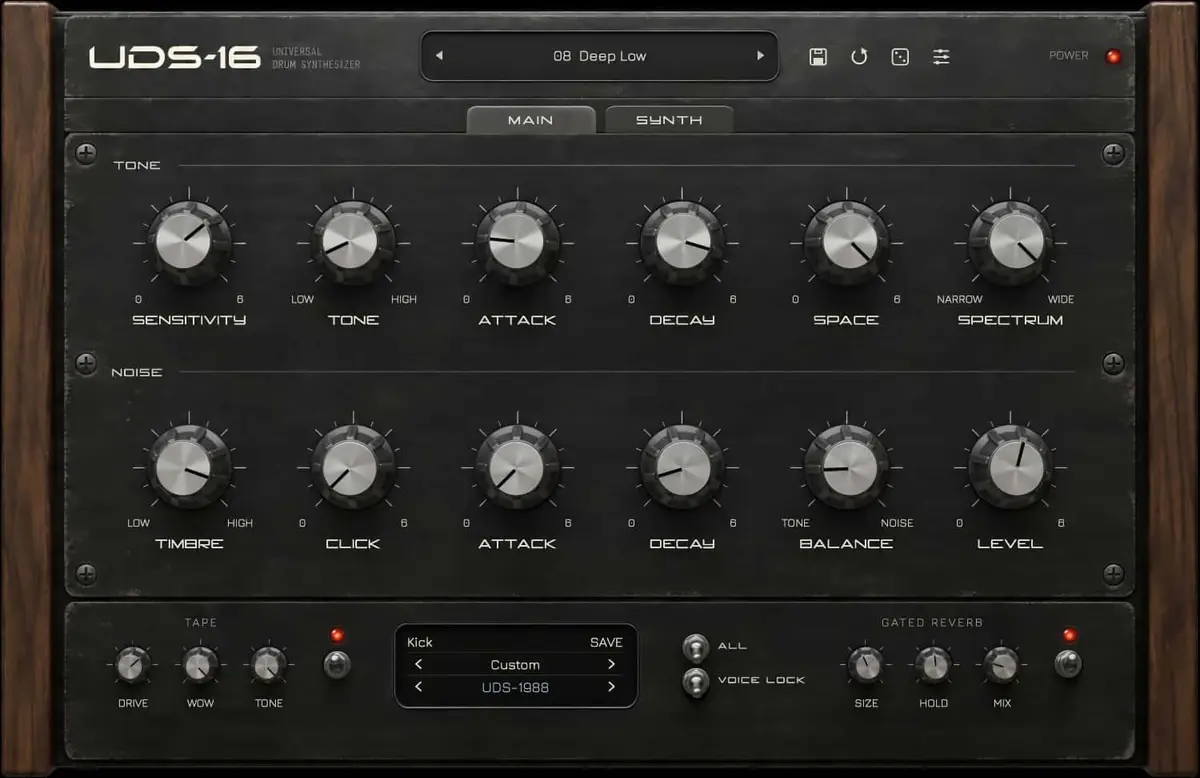
Tapechild develops UDS-16 as a software drum synthesizer for macOS and Windows, generating sounds through real-time synthesis rather than samples.
Features
Synthesis models
The instrument includes four distinct engines: UDS-1987, UDS-1988, UDS-16, and ROKTON. Two are inspired by the Lel UDS, one by the Formanta Rockton, and one is an original Tapechild design.
Tone and noise
Separate layers handle tone and noise, each with independent attack and decay controls. A resonant click control adds specific transient characteristics to the output.
Tape saturation
Drive, Wow, and Tone controls shape the signal with tape-like saturation effects. This processing is applied to the synthesized drum sounds to alter their texture.
Gated reverb
Size, Hold, and Mix parameters manage the reverb effect. This allows for the creation of short, controlled decay tails typical of gated reverb techniques.
Pitch control
The UDS-16 model features a pitched body with a pitch envelope. PUNCH and PITCH TIME controls adjust the transient and pitch behavior of the sound.
Inharmonic partials
Six inharmonic partials are available for adjustment. The MATERIAL control governs these partials, influencing the metallic or non-harmonic aspects of the tone.
Libraries
Twenty factory libraries provide complete drum kits and individual drum presets. Users can assign a different synthesis model to each drum within a kit.
Synthesis architecture
UDS-16 generates drum sounds in real time without relying on audio samples. The four synthesis models offer distinct sonic characters, with two based on the Lel UDS, one on the Formanta Rockton, and one developed by Tapechild. Each drum in a kit can be assigned a different model, allowing for varied timbres within a single instrument setup.
The signal path includes separate tone and noise layers, each with independent attack and decay controls. A resonant click control adds specific transient detail. Tape saturation is available with Drive, Wow, and Tone parameters, while gated reverb is managed through Size, Hold, and Mix controls. The original Tapechild model includes a pitched body with a pitch envelope, controlled by PUNCH and PITCH TIME. Six inharmonic partials are adjusted via the MATERIAL control.
System requirements and licensing
The software runs on macOS 11.0 or later, supporting both native Apple Silicon and Intel processors. On Windows, it requires version 10 or 11 in 64-bit format. The plugin is available as VST3 and AU on macOS, and as VST3 on Windows. Standalone applications are provided for both operating systems.
The license allows activation on up to three computers. Activation can be performed online or offline, and the software does not require an iLok or hardware dongle. MIDI control is supported with velocity-sensitive response, enabling dynamic playing expression.
Videos
Key facts
- $49 USD
- VST3, AU, Standalone
- macOS, Windows
- 16
- Up to 3 computers