
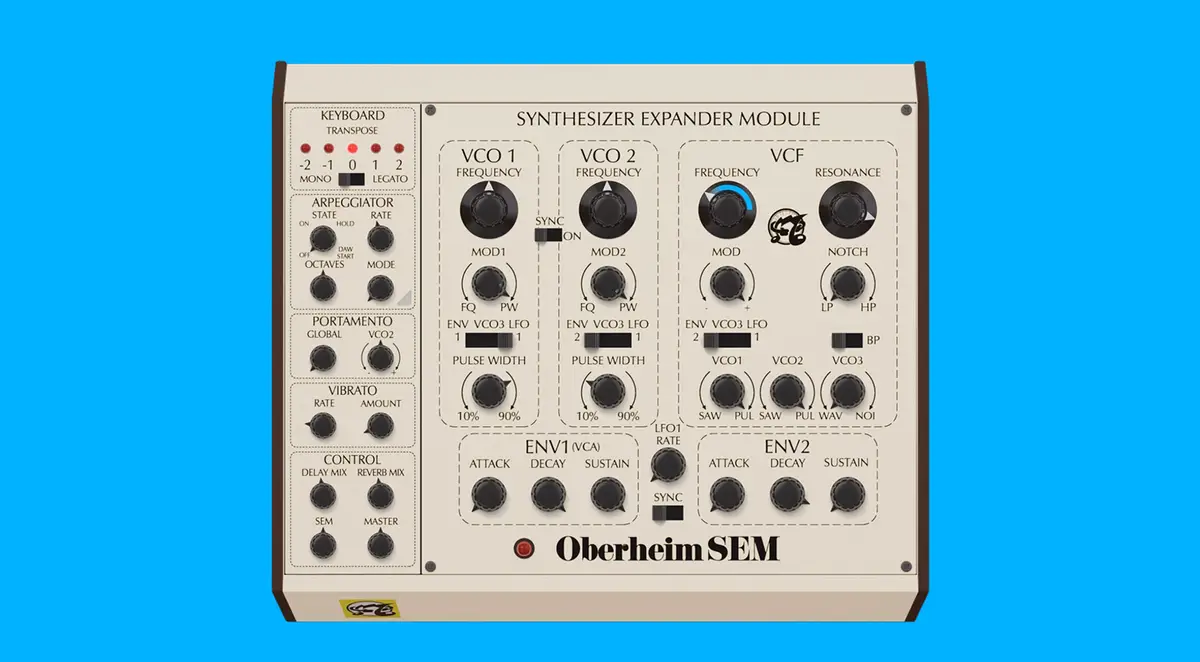
This article is a guide that lists five different software and hardware options for using the Oberheim SEM filter topology in music production.
Features
Arturia Filter SEM
A software plugin that includes the multimode filter along with a noise oscillator, soft clipping, and a modulation matrix for shaping sounds in a DAW.
Doepfer A-106-5 SEM
A Eurorack module that provides the 12dB/Oct multimode filter with CV inputs for frequency and resonance, and a separate Polarizer control.
GForce Oberheim SEM
A software emulation of the monophonic synthesizer that adds a third oscillator, an arpeggiator, and delay and reverb effects to the original design.
Behringer 2-XM
A desktop synthesizer that recreates the Two Voice with dual SEM-style filters, four oscillators, and the ability to process external audio signals.
Oberheim TEO-5
A five-voice analog polyphonic synthesizer that features the SEM filter, through-zero FM, and emulations of the Phase Shifter and Ring Modulator.
Background on the topology
The Oberheim SEM filter was originally designed by Dennis Colin and appeared in the Synthesizer Expander Module in 1974. It is a 12dB/Oct multimode design that uses a Notch control to sweep between lowpass and highpass, with an additional bandpass setting. The filter is resonant but does not self-oscillate, a characteristic that distinguishes it from other classic topologies like the Moog Ladder or MS-20. This specific circuitry became a staple in later Oberheim instruments, including the Four Voice, Eight Voice, OB-1, and OB-X.
Software and Eurorack options
For digital production, Arturia offers the Filter SEM plugin, which includes the multimode filter alongside a noise oscillator, soft clipping, and a modulation matrix. It is designed to shape synths, drums, and vocals within a DAW. Eurorack users can access the topology through the Doepfer A-106-5 SEM module. This module provides lowpass, notch, highpass, and bandpass outputs, with CV inputs for frequency and resonance. It also includes a Polarizer CV2 knob and will distort if the audio input is driven hard.
Hardware synthesizers
GForce Software provides an emulation of the full monophonic SEM, created with guidance from Tom Oberheim and Marcus Ryle. This version adds a third oscillator, an arpeggiator, and delay and reverb effects, though it does not include a standalone filter version for processing external audio. For hardware access to the filter, the Behringer 2-XM recreates the Two Voice with dual SEM-style filters and four oscillators. It can be used as a desktop unit or in a Eurorack case, and it accepts external audio for processing. The Oberheim TEO-5 is a current five-voice analog polyphonic synthesizer that features the SEM filter, through-zero FM, and emulations of the Phase Shifter and Ring Modulator. It does not have an audio input, so the filter is used only on internal sounds.
Videos
Key facts
- 1974
- Dennis Colin
- 12dB/Oct
- Software plugin
- Eurorack module
- Software emulation
- Desktop/Eurorack synth
- 5-voice analog poly